Courses for Men – Women – Children


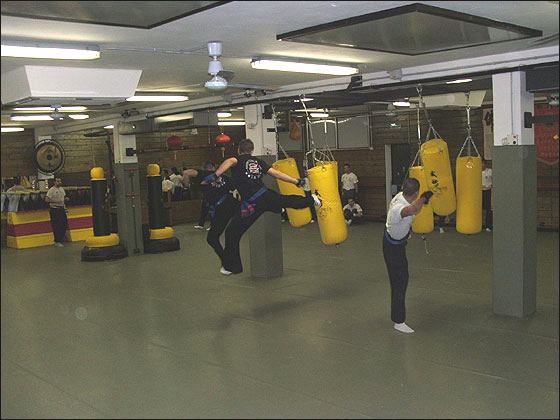

The Wushu styles included in the studying program of the Italian Wushu National Academy are described below.
Lóng Huà Quān: “fist eminent transformation”
Long Hua Quan is characterised by the “water method” (Shuì Fa), the “fire method” (Huô Fa) and the “hot water method” (Kaishuì Fa).
Chin Na San San is the pseudonym of Long Hua Quan, where Chin Na indicates the “grasping and seizing techniques”; San means three and is referred to the three Chin Na groups this style is made up of.


Long Hua Quan represents the purest expression of traditional Chinese Wushu. It is the evolution par excellence of defence and attack skills. It also makes use of 6 own weapons in all.
Barehanded techniques can be executed against one or more rivals with or without weapons. The ability to use upper and lower limbs is essential in this style. Long Hua Quan is supposed to date back to the 6th century BC. (Eastern Zhou dynasty).
Nan Shi Long Xing Quan: “dragon transformation”
This Chinese Southern style (Nan Quan) is also known as Long Ying Kwan / Mor Kiu method of the famous Lam Jia school.
This style is characterised by wide and quick movements, especially circular ones, which imitate the spiral movements of the dragon’s claws. Extremely important are hip movements and balance techniques, as well as steps and both hand and arm techniques. Frequent use is made of sweeps (Sao Tui).This style offers a very wide program ranging from Jibengun to Bu Fa, from Buxing to Chaolié kunghé and Daodi Fa. Furthermore, it comprises several practical applications performed both solo and in pairs and in a continuous sequence.This style implies learning the “9 forms” (Jiu Taolu), weapon techniques (Qixié) as well as the Long Xing Chin Na and Mor Kiu methods. The latter method constitutes the deep essence of this style. Particular attention is paid to preset fighting exercises and pure traditional fighting (Sanshou – Duilan).
Xing Yi Quan: “fist transformation within the will and the spirit”
The name of this style is also translated as “boxing and mind form” or “form-mind boxing”.
Xing = “form”, “to transform”
Yi = “mind”, “will”
Quan = “fist”, “boxing”
Xing Yi Quan represents a way of boxing where intellect and fighting strategy lead and change techniques into a single entity between mind and body. The 12 animals belonging to the family of this style are: dragon, monkey, tiger, snake, horse, cock, crocodile, swallow, hawk, pigeon, eagle and bear.
Xing Yi Quan is a very powerful internal style (Nei Jia). It requires a significant movement ability, leg power, high flexibility in the hips, a perfect synchronism between lower and upper limbs and a distinct sense of balance.
Note: for instructors only. NOT for beginners.
Ba Gua Zhang: “eight trigram palm”Ba = 8;
Gua = “trigram”;
Zhang = hand “palm”
Ba Gua is an internal style, too. The eight trigrams belong to the traditional Chinese culture and philosophy, which are linked with the Taoist world.
The eight trigrams are referred to the esoteric roots this style is equally based on.
This results from prophetic interpretations of Yi Ching, characterised by 64 hexagrams, each made up of three overlying horizontal broken or unbroken lines.
Ba Gua Zhang is the art of the circular movement par excellence. All movements are performed around an imaginary circle having a diameter ranging from 1.80 meter to approximately 3 metres. Ba Gua Zhang followers describe its circumference with sinuous foot movements by slipping steps, rotating around themselves and back in the opposite direction.
The movement is executed by tracing a long 8-shaped elliptical-circular outline. All this is always exceptionally round: both attack and defence techniques.
The technique begins extremely slowly to allow the spirit to calm down and to make sure the practitioner can feel totally conscious of the complex physiological and psychological processes involved. Furthermore, this calm state enables Qi, the ”vital energy”, to freely flow into each fibre and cell inside the body.
The defence and/or attack postures performed in Ba Gua are called “dynamic”.
These imitate the snake, the lion, the dragon, the white monkey and the hawk.
Note: for instructors only. NOT for beginners.
Tai Ji Quan: “grand ultimate fist”
Tai Ji Quan represents an important branch of the Chinese martial tradition.
Its name derives from the philosophical expression Tai Ji, “great beginning”.
The internal styles are superior to the external ones (Wai Jia) in terms of difficulty, but still they are not impossible to learn.
All internal styles have Taoist roots.
Tai Ji Quan, Xing Yi Quan and Ba Gua Zhang constitute the triad of internal styles.
The movements of Xing Yi, Ba Gua and Tai Ji show they belong to the Wushu internal family, which is entirely inspired by the postulates of Taoist metaphysics.
The Chinese are used to attribute the Tai Ji Quan origin to Chen Wang Ting, although this style was most likely created by the Taoist monk Zhàng San Féng, who lived in AD 1300. Chen Wang Ting was a secular Taoist and lived in 1500; he created the homonymous Chen method.
In the first Chen style of Tai Ji Quan the “old frame” was distinguished from the “new” one during the 14th generation; later on it resulted in the Tai Ji Quan of the Yang, Wu (Tiyi Jia), Sun, Wu (Tiér Jia) and Hào Hé schools.
Therefore, famous Tai Ji masters came out of the Chen school and developed in turn their own methods even though, to tell the truth, all of them were influenced by the principles Master Chen Wang Ting had outlined when he was still alive, thus affecting the future of all the other five methods or styles the great Tai Ji Quan family is composed of
Note: for instructors only. NOT for beginners.
Qi Gong: “art of breathing” – (pronunciation: Ci Kung)
Qi = “breath”, “vital energy”;
Gong = work needed to produce such energy
The basic goal of practicing Qi Gong is achieving longevity by nourishing and preserving the “three gems”. This happens by means of various routines and techniques centred especially on the “regulation of the body” (Tiao Shen), which is reached practicing different kinds of “physical exercises” (Lian) and applying the “posture method” (Bu Fa).
The “regulation of the breath” is composed of scores of techniques and breathing exercises linked with the Qi.
Finally there is Tian Xin, which consists in meditation techniques and enables the practitioner the detachment from any kind of emotion.
Note: for instructors only. NOT for beginners.
Ba Wang Lian Xuexiao: “8 Wang Lian School”
This style is also known as “School of the 8 imperial exercises”, Chinese Northern style belonging to traditional Chang Quan.
This style was developed in the period between the Song and Ming imperial dynasties and was intended to be used exclusively by military classes. Its founders were Master Hu Xiao Li, who lived under the Song dynasty, and Luò Chang Mo. Luò Chang Mo was not only a famous general and a weapon master of the Ming dynasty but also the lieutenant of great general Xu Da, the one who defeated the Mongol Yuan dynasty in the year 1368.
This style is characterised by straight lines and is very difficult from a physical and technical standpoint. It is mainly based on 8 Wang Lian, known as the “8 imperial exercises”. These are extremely complex proper routines (Taolu), in particular the 7th and the 8th instructors instructors Wang Lian. For this style the practitioner must have physical prowess and agility, as well as a very good sense of coordination of the upper and lower limbs.
Furthermore, the studying program includes Jibengun, Bu Fa, Buxing, Phingheng, Chaoliè Kunghé, Taolu, Qixié and Ba Wang Chin Na. There is also a particularly wide program concerning preset and classic fighting.
In spite of its strictly military marks, this school was inspired by Buddhism in the purest Chan tradition. In any case, it follows the “three principles” or “three practices” (San Shiji), namely “writ” (Jiàogui), “meditation” (Chénsi) and “wisdom” (Zhìhuì).
Note: for instructors only. NOT for beginners.
Nan Quan: “Southern fist”
This name identifies all Wushu styles originated in China south of the major Yangtze river (Changjiang). This is a very large geographic area where each province gave birth to styles which are very peculiar and different from one another. Nan Quan and Chang Quan are not two specific Wushu styles but each represents several different stylistic realities as a whole. Nan Quan includes all Chinese Southern styles, whereas Chang Quan includes the Northern styles.
Typical of Nan Quan are powerful movements and vigorous defence and attack techniques both with hands and legs. Lower limbs stay steady on the ground. Positions are extremely low and stable, steps are tight and energetic. The practitioner occasionally utters a ventral cry (Fashenghanjiao).
The most widespread Nan Quan styles are: Yunchun and Wuzu (Fujian province), the styles of the Hong, Liu, Cai, Li and Mo families, as well as Long Ying Quan (Lam family),Wu Lin Nan and Huang Feihong (Guangdong province). It should be noticed that some other provinces located in Southern China produced particular and fascinating Wushu styles too.
 Accademia Nazionale Italiana Wushu
Devi effettuare l'accesso per postare un commento.